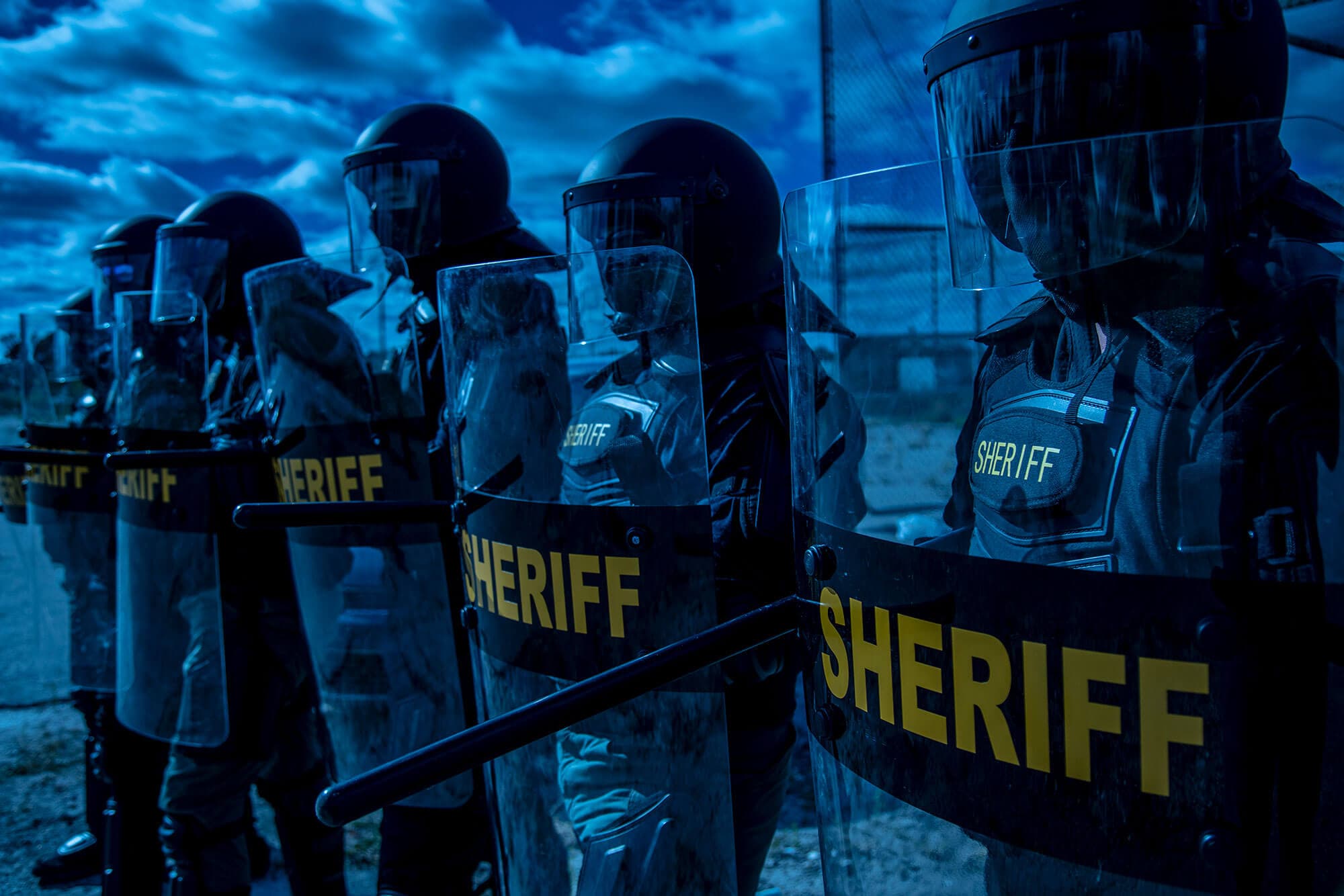
Not every officer in a crowd control deployment needs the same kit configuration. Roles differ and equipment should follow. But five pieces form the baseline that every officer who may have direct crowd contact should have access to. Missing any one of them creates a specific, predictable vulnerability.
1. A Properly Fitted Riot Helmet
Head and face injuries are the most serious category of crowd control injuries and the most preventable with correct equipment. A riot helmet that does not fit correctly does not protect correctly: a helmet sitting too high does not provide full face shield coverage, and a helmet that shifts during movement can expose the face at the moment of impact. Haven Gear helmets are available across a full size range including Jumbo for officers whose head circumference falls outside the standard range. View Helmets →
2. Full Torso and Limb Coverage
A suit that covers the torso without covering the limbs creates predictable injury points at the arms and legs, which are directly in the path of thrown objects and crowd contact. Haven Gear's Enforcer MP integrates full limb coverage into a single suit system that stays positioned correctly during movement. The Patrol suit provides the same coverage in a configuration appropriate for deployments where visible riot gear is not operationally suited. View Suits →
3. Tactical Gloves
Hands are in contact with equipment, crowds, and potential improvised weapons throughout an active deployment. Standard patrol gloves are not built for this exposure. Hard knuckle or Kevlar-lined tactical gloves protect against impact and cuts while maintaining the dexterity officers need to operate batons, radios, and other equipment. View Gloves →
4. Polycarbonate Shield
The shield is the primary tool for maintaining standoff distance and deflecting thrown objects in a line formation. A 4mm polycarbonate shield provides the impact resistance needed for sustained crowd contact while giving officers clear visibility of what is in front of them. Officers without shields in a formation are the gap that crowds focus on. View Shields →
5. Anti-Riot Baton with Wrist Lanyard
The baton provides a less-lethal force option for officers beyond the range where physical contact is unavoidable. The wrist lanyard keeps the baton in the officer's possession during contact. Choosing the right length matters: 28 inches for most deployment contexts, 34 inches for line formation officers who need extended standoff distance. View Batons →