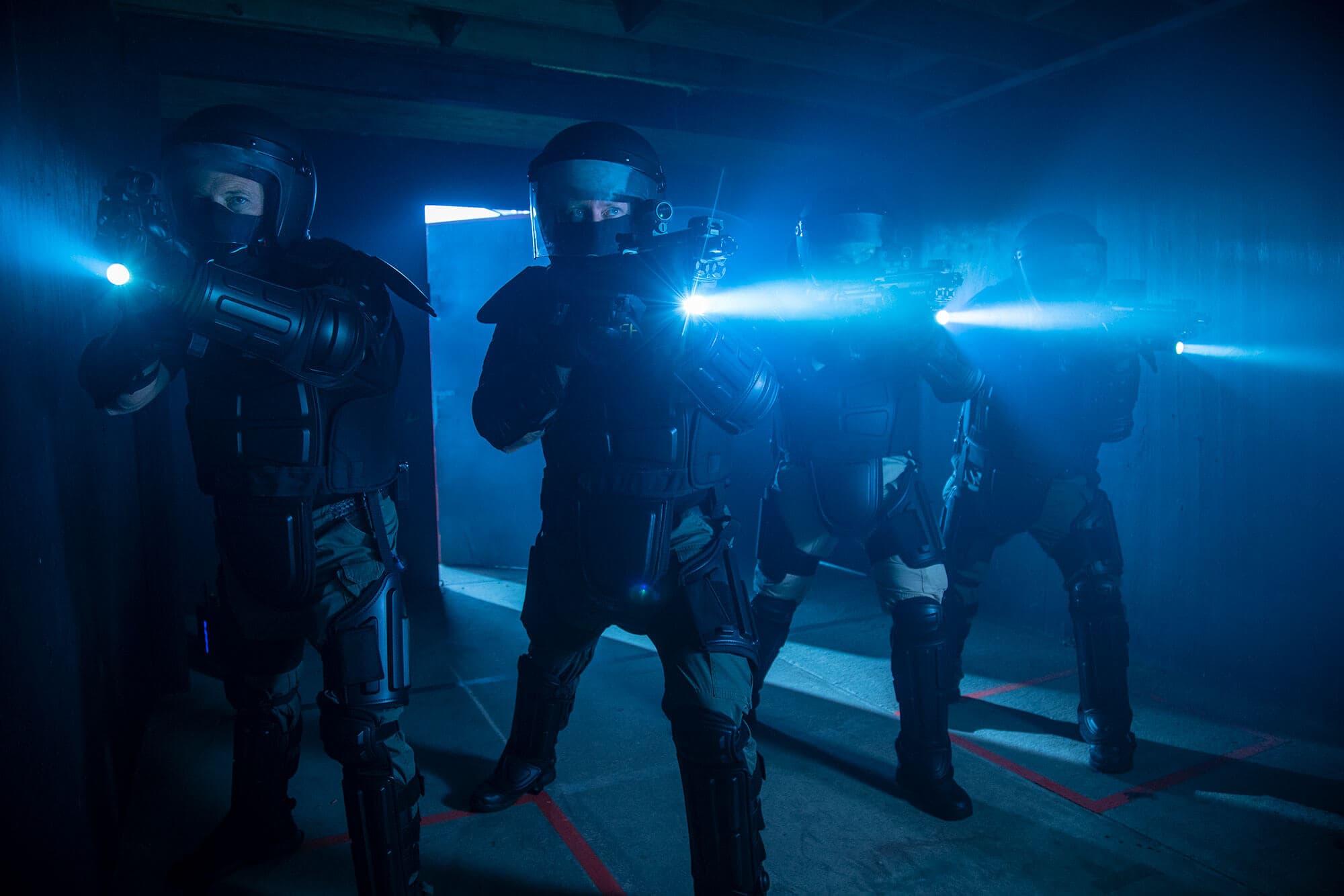
Riot gear and ballistic protection are often treated as separate categories, and for most riot suits they are. Standard riot gear is designed to resist impact, blunt force, chemical exposure, and in some cases bladed weapons. Ballistic protection requires a different material set and a different design approach. The question for any department is whether their deployment scenarios require integration of both.
What Standard Riot Gear Protects Against
A well-built riot suit provides protection against thrown projectiles, batons and clubs, chemical splash, fire exposure, and in certified configurations, bladed weapon strikes. The Enforcer MP meets British Standard BS 7971-3:2002 for impact protection and DIN 53438 for fire resistance. These cover the threat profile for the large majority of crowd control scenarios law enforcement encounters.
When Ballistic Protection Becomes Necessary
Situations involving armed suspects, high-risk warrant service, or civil unrest with documented firearm presence require officers to address ballistic threats on top of the standard riot threat profile. The NIJ sets the ballistic protection standards relevant to law enforcement body armor, and those standards apply regardless of whether the carrier is a standalone vest or integrated into a riot suit.
The Enforcer MP's integrated multi-function ballistic carrier supports hard plates, soft armor panels, spike armor, and butterfly panels. This means officers deploying into situations with mixed threat profiles do not have to choose between riot protection and ballistic protection. Both are in the same system.
Matching Protection Level to Deployment Type
Not every deployment requires maximum protection. The Patrol suit is appropriate for lower-risk crowd management situations where weight and mobility are priorities. The Enforcer MP is appropriate when the threat profile includes the possibility of escalation to ballistic threats. The full suit comparison breaks down which configuration fits which deployment scenario.
Procurement decisions that match protection level to actual deployment requirements also control costs. Equipping every officer with maximum coverage for situations that call for patrol-weight gear is expensive and creates unnecessary fatigue. Getting the match right is what makes a gear program operationally sustainable.