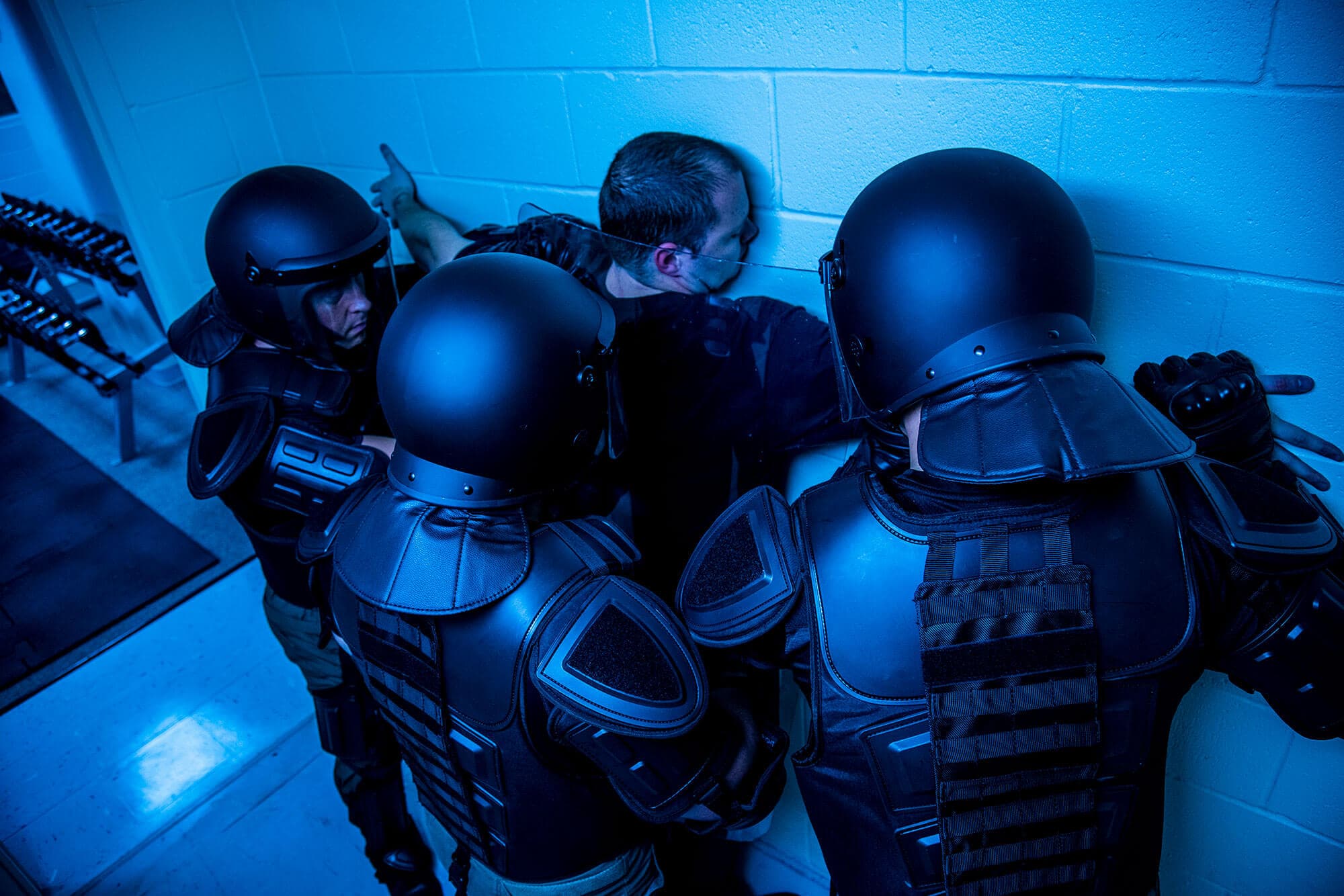
Personal safety for law enforcement officers in high-risk operations is not primarily a gear question, though gear matters. It is the intersection of protective equipment, tactical training, situational awareness, and unit coordination. Officers who are well-equipped but poorly trained or operating in a disorganized unit are more vulnerable than officers who are well-trained in good gear with strong unit discipline.
Gear as the Foundation
Protective equipment sets the baseline for survivability in the event of an incident. An officer who is struck by a thrown projectile while wearing impact-rated riot gear will sustain a different injury than one in standard patrol gear. This is the floor. The Enforcer MP and Patrol suit are designed to provide that floor for different deployment intensities. But the gear is the starting point, not the complete answer.
The National Institute of Justice officer safety research consistently shows that protective equipment use reduces injury severity but that officer behavior and tactical decisions are the primary determinants of whether an incident occurs at all.
Situational Awareness Under Gear Constraints
Riot gear changes sensory inputs. Peripheral vision is reduced by helmets. Hearing is affected by helmet coverage. Touch sensitivity is reduced by gloves. Officers need to train specifically for operating under these constraints. The techniques for maintaining situational awareness in full gear are different from those used in standard patrol, and they require deliberate practice.
Unit Coordination and Mutual Protection
In crowd control operations, individual officer safety is partly a function of unit cohesion. An officer with a gap in their formation line is exposed from the flank. An officer whose teammates are not covering the same threat vectors is exposed in ways that individual gear cannot compensate for. Unit-level training in riot gear configurations is as important to personal safety as individual protective equipment selection.