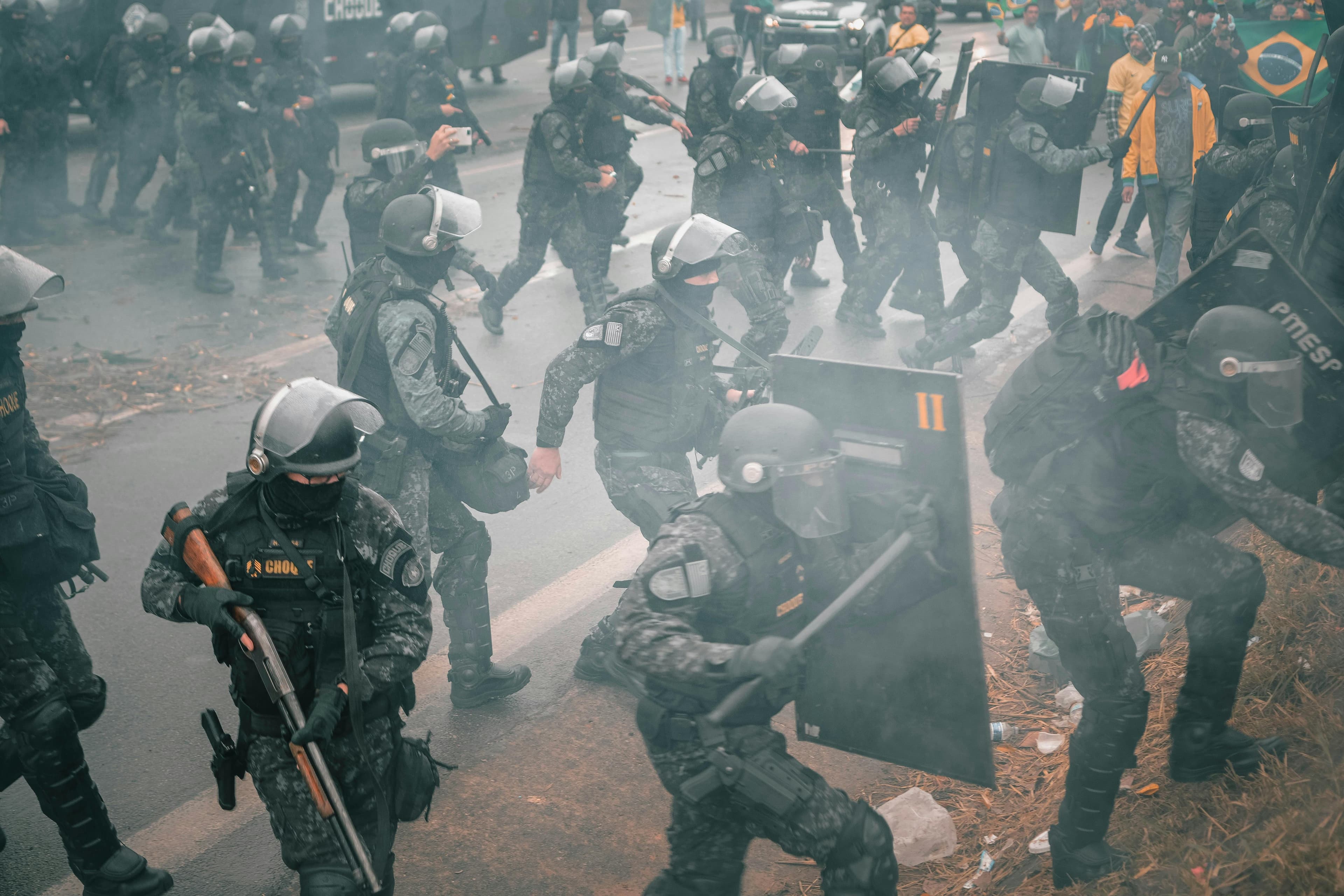
The use-of-force continuum is a useful conceptual framework. Applying it in a crowd control operation, where situations are dynamic, threats can emerge from multiple directions simultaneously, and decision time is compressed, requires more than understanding the framework. It requires trained decision-making protocols that can be executed under operational stress.
Multiple Threat Vectors Simultaneously
In a crowd control line, officers face potential threats from multiple directions at the same time. A thrown object from the crowd front, a physical confrontation at the left flank, and a crowd surge at the right are all occurring simultaneously. The use-of-force continuum was originally designed as a sequential framework. Real crowd control situations require parallel decision-making across multiple threat vectors at once. Training for this requires scenario complexity that basic continuum instruction does not provide.
Police Chief Magazine has published analysis of crowd control use-of-force incidents noting that the most common training gap identified in after-action reviews is preparation for simultaneous multi-vector threat assessment rather than sequential single-threat decision-making.
Crowd Control-Specific Force Options
The force options available in crowd control situations differ from those in standard patrol encounters. Chemical agents, crowd dispersal devices, mounted pressure, and formation advancement are force options specific to crowd environments that are not part of standard use-of-force continuum training. Each of these options has specific policy thresholds, training requirements, and documentation needs that should be incorporated into crowd control-specific use-of-force training.
The protective gear an officer wears affects which crowd-specific force options are available. Officers in full Enforcer MP configuration with gas mask compatibility have different chemical agent-related options than officers without appropriate respiratory protection. Gear selection and force option availability are connected in crowd control contexts in ways they are not in standard patrol contexts.
Post-Incident Documentation
Force used during crowd control operations requires documentation that addresses the specific complexity of the crowd environment. Single-subject incident reports do not capture the simultaneous multi-subject dynamics of crowd operations. Departments that develop crowd control-specific incident documentation templates produce more useful post-incident records for review, litigation, and training improvement purposes. See Part 1 of this series →