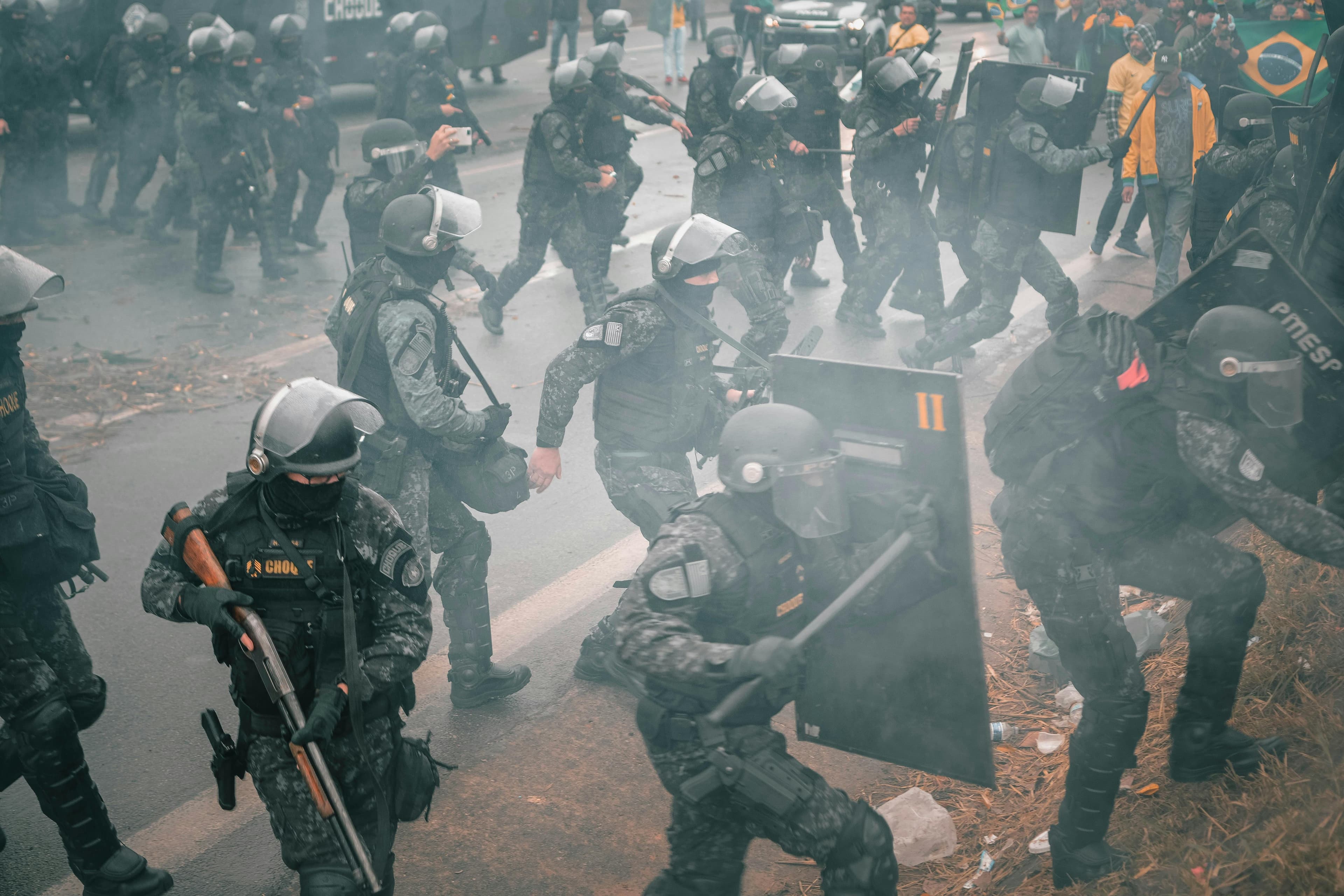
Riot gear fails in ways that are not always visible. A polycarbonate face shield that looks intact may have internal micro-fractures from a previous impact. Foam panels in a five-year-old suit may have compressed to the point where they transmit force rather than absorb it. Stitching at a critical joint may be at the edge of tensile failure. Gear that passes a visual locker inspection and gear that protects an officer under real force are not always the same thing.
Durability in riot equipment means holding the line between the two for as long as possible.
What Riot Gear Has to Withstand
A riot helmet must stop thrown objects ranging from coins to full glass bottles without fracturing or deforming in ways that reach the officer's head. A shield must absorb repeated direct strikes without delaminating, crazing, or transferring force through the handle grip. A suit must resist blunt force, stab threats, and in some configurations incendiary exposure, while remaining flexible enough for officers to stay mobile across hours of deployment.
Equipment that does any of these partially is not adequate for the situations that actually occur. The threat does not adjust to the gear's performance ceiling.
Materials That Hold Up
Haven Gear builds its suit panels from molded polypropylene selected for its combination of blunt force resistance, stab resistance, and fire resistance. The Enforcer MP's shell meets British Standard BS 7971-3:2002, DIN 53438, and ISO 6941 for flame resistance. Polypropylene does not degrade from UV exposure the way some synthetic materials do, which matters for equipment that spends significant time in vehicle trunks between deployments.
Shields use 4mm riot-grade polycarbonate manufactured by Paulson Manufacturing and meeting international standard GA294-2001. The 4mm thickness is the working minimum for repeated strike resistance in active deployment. Thinner polycarbonate looks similar and performs similarly in controlled conditions but fails differently when subjected to repeated impact over a deployment lifecycle.
Where Gear Actually Fails
The durability of protective equipment comes down to two things more than material selection: attachment points and stitching. Panels that are well-sewn to their backing and straps that are properly anchored will outlast panels attached with minimal thread passes at stress points. Haven Gear suit components use high-density stitching at all load-bearing connections, which is the area that fails first in cheaper equipment.
Closure systems use hook-and-loop material that maintains grip through repeated attachment cycles. Hardware at points that bear weight is metal, not plastic. These are construction details that determine whether gear is still functional after two years of regular deployment or whether it has quietly degraded past the point of reliable protection.
Replacement Parts Extend Total Lifespan
A complete suit does not need to be replaced when a single component reaches the end of its useful life. Haven Gear manufactures and stocks individual replacement components for every suit in the lineup: arm protectors, thigh protectors, leg guards, groin guards, and helmet parts. Departments that replace targeted components as needed get significantly longer total value from their gear investment than those who treat kit replacement as all-or-nothing.
Face shields should be inspected for crazing after any direct impact. Foam inserts should be checked for compression annually. These degrade first, cost the least to address, and are the most likely to fail silently without a replacement schedule.
The Lifecycle Cost Calculation
The choice between properly built gear and cheaper alternatives shows up in the second and third year of deployment. Panels that hold up through the first season and fail in the second have a real cost, in replacement expense and in the operational risk of gear that an officer believes is protecting them but is no longer performing to standard.
Departments that track this over multiple procurement cycles consistently find that the total lifecycle cost of quality gear is lower than cycling through cheaper options, before accounting for the harder-to-quantify cost of an officer injury from equipment that failed at the wrong moment.